
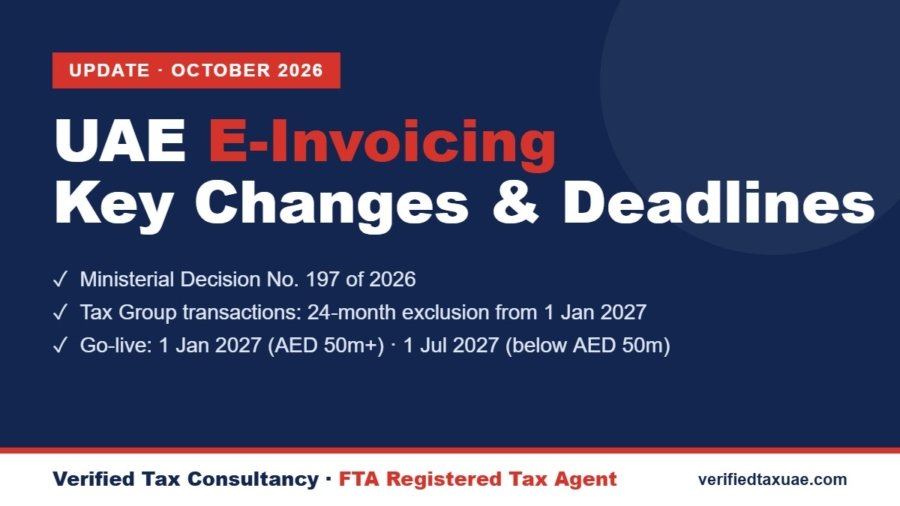
UAE e-invoicing is no longer a future project. The Ministry of Finance has amended the e-invoicing rules again in October 2026, the deadline for large businesses to appoint an Accredited Service Provider (ASP) has just passed, and mandatory go-live for the first group of businesses is 1 January 2027. This guide explains, in plain English, what changed, which deadline applies to your business, and what to do next.
What changed in October 2026
On 19 October 2026 the Ministry of Finance announced Ministerial Decision No. 197 of 2026, which amends Ministerial Decision No. 243 of 2025 on the Electronic Invoicing System. The Decision took effect on 1 October 2026. The Ministry says its aim is to give businesses more clarity, reduce operational burden and allow more flexibility during implementation. The key changes are:
- Tax Group transactions: business transactions between members of the same VAT Tax Group are excluded from e-invoicing for 24 months starting 1 January 2027.
- Airline cargo: international transport of goods by airlines where an Airway Bill is issued is excluded for a temporary 24-month period.
- Data storage: the requirement to store e-invoice data inside the UAE has been removed. You must still keep all e-invoices, e-credit notes and related data for the period set by the Tax Procedures Law and provide them to the Federal Tax Authority (FTA) on request.
- System failure notice removed: the old rule requiring you to notify the FTA within two business days of a system failure has been repealed.
- Time limit to issue: an e-invoice or e-credit note must generally be issued and transmitted through the e-invoicing system within 14 business days from the date of the business transaction.
Shortly after, on 26 October 2026, the Ministry published Version 2.0 of the UAE Electronic Invoicing Guidelines, and its e-invoicing page now lists Cabinet Decision No. 173 of 2026 on violations and administrative penalties for breaching the e-invoicing legislation.
UAE e-invoicing deadlines: which one applies to you?
The timeline is set by Ministerial Decision No. 244 of 2025, as amended by Ministerial Decision No. 66 of 2026 (which moved the ASP deadline for large businesses from 31 July 2026 to 30 October 2026).
| Who | Appoint an ASP by | Go live by |
|---|---|---|
| Businesses with revenue of AED 50 million or more | 30 October 2026 | 1 January 2027 |
| Businesses with revenue below AED 50 million | 31 March 2027 | 1 July 2027 |
| Government entities | 31 March 2027 | 1 October 2027 |
“Revenue” here means the gross income earned during your most recent accounting period, based on your financial statements (or other documents acceptable to the FTA if financial statements are not available). That is one more reason to keep your books up to date.
A pilot and a voluntary phase have been running since 1 July 2026. According to the Ministry’s guidelines, e-invoicing penalties do not apply to invoices issued voluntarily before your mandatory date.
Does e-invoicing apply to retail (B2C) sales?
Not yet. Under Ministerial Decision No. 244 of 2025, business-to-consumer (B2C) transactions are not subject to the e-invoicing system, and a business that deals only with consumers is not subject to it, until the Minister of Finance decides otherwise. If you sell to both businesses and consumers, your business-to-business sales are still in scope.
What this means for Abu Dhabi businesses
If your revenue is AED 50 million or more, you should already have an ASP in place and be testing, with only a few weeks left before 1 January 2027. If you are part of a VAT Tax Group, the new 24-month relief means invoices between group members do not need to go through the system from day one, but your invoices to outside customers still do.
Most small and medium-sized businesses in Musaffah and across Abu Dhabi fall into the below-AED-50-million group. That gives you until 31 March 2027 to choose an ASP and until 1 July 2027 to go live. That sounds far away, but choosing a provider, cleaning up customer data (such as TRNs) and updating your accounting software all take time.
What you should do now
- ☐ Check your revenue for your most recent accounting period to confirm your phase and deadlines.
- ☐ If you are in the AED 50 million+ group, confirm your ASP appointment is complete and plan testing before 1 January 2027.
- ☐ If you are below AED 50 million, shortlist ASPs from the Ministry’s accredited list and plan to appoint one well before 31 March 2027.
- ☐ Review your customer master data: names, addresses and TRNs must be accurate.
- ☐ Ask your software provider how it will connect to your ASP.
- ☐ Set up a process to issue and transmit e-invoices and e-credit notes within 14 business days.
- ☐ Confirm your record-retention policy meets the Tax Procedures Law period.
- ☐ If you are in a VAT Tax Group, map which transactions are intra-group and which are not.
Frequently asked questions
Do I still have to store my invoice data in the UAE?
No. Since 1 October 2026 the in-country storage requirement has been removed. You must keep the records for the period set by the Tax Procedures Law and make them available to the FTA on request.
My company is in a VAT Tax Group. Am I exempt?
Only for transactions between members of the same Tax Group, and only for 24 months starting 1 January 2027. Sales to customers outside the group must follow the normal e-invoicing rules.
I only sell to walk-in customers. Do I need e-invoicing?
Not for now. Businesses that deal exclusively in B2C transactions are outside the system until the Minister issues a decision bringing them in.
Get e-invoicing ready with an FTA registered tax agent
Verified Tax Consultancy is an FTA registered tax agent in Abu Dhabi. We can confirm your e-invoicing phase, review your VAT invoicing and records, and help you prepare before your deadline. WhatsApp us on +971 56 504 3875 or call +971 56 145 0098. Visit our office in Musaffah M-33, Abu Dhabi.
Related reading: FTA Decision No. 17 of 2026: recovering input VAT on employee expenses · Cabinet Decision No. 129 of 2025: updated tax penalties · More UAE tax updates
Sources
- Ministry of Finance – Amends Electronic Invoicing Regulations to Ease the Burden on Businesses (19 Oct 2026)
- Ministerial Decision No. 197 of 2026
- Ministerial Decision No. 244 of 2025 and Ministry of Finance – Targeted amendments (Ministerial Decision No. 66 of 2026)
- UAE Electronic Invoicing Guidelines, Version 2.0 (26 Oct 2026)
- Ministry of Finance – eInvoicing page
This article is general information based on official sources as of 2 November 2026 and is not legal advice for your specific situation.